
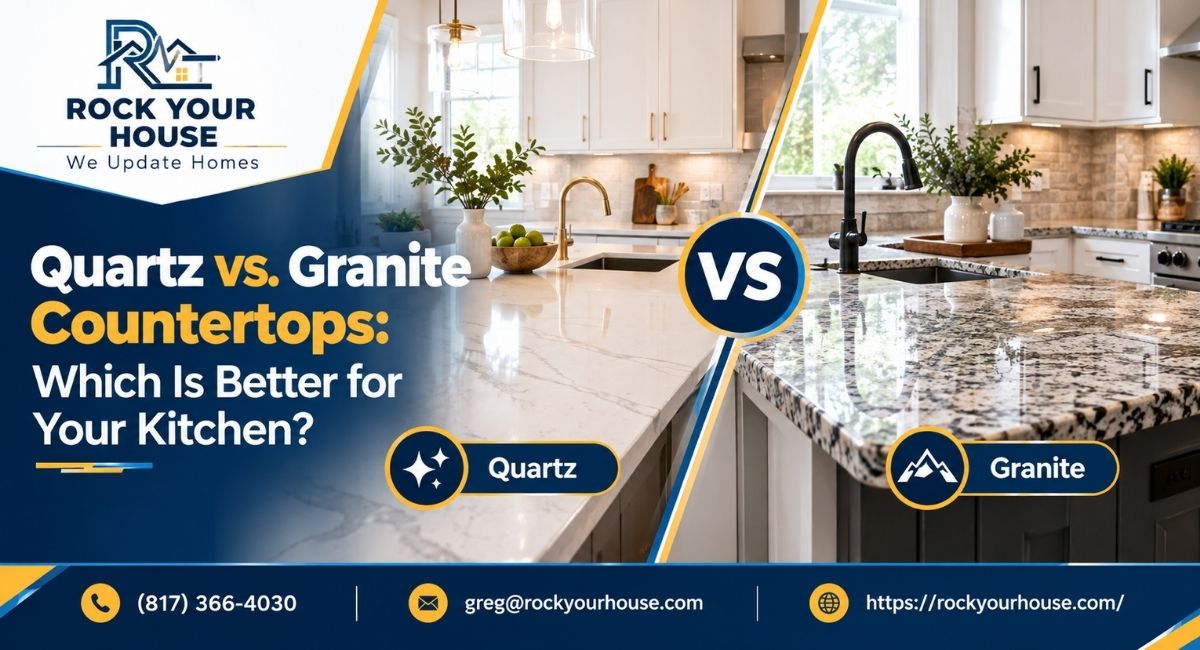
You are standing in a stone yard, staring at slab after slab, and the sales rep just asked which you want: quartz or granite. Both look beautiful under the showroom lights. Both come with a price tag that makes this decision feel permanent. And honestly, you are not sure what actually separates them beyond the name.
This is one of the most common questions homeowners face during a kitchen remodel. Quartz and granite sit at the top of the countertop market for good reason. They are both durable, both add real value to a kitchen, and both come in dozens of colors and patterns. But they are not the same material, and the differences matter once you start cooking, cleaning, and living with your counters every day.
This guide walks through how quartz and granite compare on durability, heat resistance, maintenance, appearance, and cost. By the end, you will have a clear sense of which one fits your kitchen and your daily habits.
Understanding What You Are Actually Comparing
Granite is a natural stone, cut directly from quarried rock. Every slab is unique, formed over millions of years from cooling magma packed with quartz, feldspar, and mica. No two granite slabs look exactly alike, which is part of its appeal.
Quartz countertops are engineered, not mined whole. Manufacturers grind natural quartz crystal, roughly 90 to 95 percent of the material, and bind it with polymer resins and pigments under pressure. The result is a manmade slab that mimics stone while offering more consistency from piece to piece.
That basic difference, natural versus engineered, drives almost every other distinction between the two materials.
Quartz vs Granite: Side-by-Side Comparison
| Factor | Quartz | Granite |
|---|---|---|
| Material type | Engineered stone | Natural stone |
| Sealing required | No | Yes, periodically |
| Heat resistance | Moderate, avoid direct hot pans | High, handles direct heat better |
| Scratch resistance | Very high | High |
| Pattern consistency | Uniform, repeatable | Unique per slab |
| Typical cost per sq ft installed | $50 to $120 | $40 to $100 |
| Maintenance | Low, wipe clean | Moderate, needs resealing |
Costs shift depending on the specific slab, region, and fabrication complexity, so treat these as general ranges rather than a fixed quote.
Durability: Where the Two Materials Really Differ
Both quartz and granite rank as hard, long-lasting materials on the Mohs hardness scale, which measures scratch resistance from 1 to 10. Granite typically scores between 6 and 7. Quartz composite slabs test slightly higher, often around 7, largely due to the manufacturing process that binds the material under intense pressure.
In practical terms, this means neither surface scratches easily during normal kitchen use. You would need to drag something unusually hard, like a cast iron skillet with real force, to leave a mark on either one. For everyday chopping, sliding pots, and general wear, both hold up well.
Where they split is impact resistance. Granite can chip at the edges if it takes a sharp, hard hit, such as a heavy pot dropped directly on a corner. Quartz, because of its engineered composition and resin binder, tends to resist chipping slightly better in that specific scenario.
Heat Resistance: A Real Practical Difference
This is one area where granite has a clear edge. Granite formed under extreme geological heat, so it handles direct contact with hot cookware reasonably well. A hot pan set straight from the stove onto granite generally will not crack or discolor the surface.
Quartz is different. The polymer resin that binds the material starts to discolor or can warp at sustained temperatures above roughly 300 degrees Fahrenheit. Manufacturers like Caesarstone specifically advise against placing hot cookware directly on quartz surfaces. If you cook often and tend to move pots straight from stove to counter without thinking, this is worth weighing seriously. A detailed comparison of durability and heat performance breaks this down further if you want to dig into the specifics.
In practice, most homeowners solve this with trivets, which works fine as long as you remember to use them consistently.
Maintenance: Sealing, Staining, and Everyday Cleaning
Granite is a porous natural stone, which means it needs periodic sealing to resist staining and moisture penetration. Most granite countertops need resealing every one to three years, depending on the specific stone and how much wear it sees. Skipping this step can lead to staining from oil, wine, or acidic foods that soak into the surface instead of wiping away.
Quartz does not require sealing at all. Because it is engineered and non-porous, it resists staining and bacteria growth without any maintenance beyond regular cleaning. For a busy household, this difference adds up. Wiping quartz down with mild soap and water is typically all it needs.
That said, quartz has its own care requirements. Harsh cleaners, high pH products, and abrasive pads can damage the resin over time, so it is not entirely maintenance-free, just lower maintenance than granite.
A few quick care notes for each material:
- Granite needs resealing periodically and should avoid harsh acidic cleaners on unsealed sections.
- Quartz should avoid direct heat and strong bleach-based cleaners that can affect the resin.
Appearance and Design Flexibility
Granite’s biggest appeal for many homeowners is its natural variation. No two slabs are identical, and that uniqueness is part of the draw for anyone wanting a countertop that feels one of a kind. Veining, mineral deposits, and color shifts within a single slab give granite a organic, high-end look that engineered materials cannot fully replicate.
Quartz offers the opposite advantage: consistency. If you are matching countertops across a large kitchen island, multiple rooms, or need seamless pattern continuity, quartz makes that far easier. Manufacturers can also produce quartz in colors and patterns that do not occur naturally, including pure whites and bold solid tones, which gives homeowners more design flexibility for modern or minimalist kitchens.
Both materials pair well with a wide range of cabinetry styles, from traditional wood tones to high-contrast modern finishes. The right choice often comes down to whether you want a countertop that feels unique to your home or one that offers predictable, repeatable design across a larger space.
Cost Comparison: What You Can Expect to Pay
Pricing for both materials varies widely based on slab grade, thickness, edge profile, and regional labor costs. As a general guide, granite installed typically runs from about $40 to $100 per square foot, while quartz tends to run slightly higher, from roughly $50 to $120 per square foot installed. Premium quartz brands with strong warranties and exotic granite slabs with dramatic veining both push toward the higher end of their respective ranges.
For a typical kitchen with 30 to 45 square feet of countertop space, homeowners can expect a mid-range granite project to land somewhere between $2,500 and $4,000, while a comparable quartz project often falls between $3,000 and $5,500. These numbers shift based on your specific layout, edge choices, and whether you are adding an island.
If you want numbers specific to your kitchen, a kitchen remodeling Prices estimate that accounts for your square footage and finish level gives a far more useful picture than a general online range.
Real Scenarios: Matching the Material to Your Kitchen
The household that cooks constantly. If pots go from stove to counter often, granite’s heat tolerance is a real practical advantage. It reduces the risk of accidental resin damage from a moment of forgetting a trivet.
The busy family with little time for upkeep. Quartz’s low maintenance, no sealing, easy wipe-down cleaning, fits well here. Between work, school schedules, and everything else, not having to remember a resealing schedule is a genuine convenience.
The homeowner who wants a one-of-a-kind kitchen. Granite’s natural variation delivers a look that cannot be duplicated. If you have seen a specific slab you love at a stone yard, that uniqueness is part of the appeal.
The homeowner matching a large kitchen or open floor plan. Quartz’s pattern consistency makes it easier to carry the same look across a large island, perimeter counters, and even a matching backsplash without visible seams standing out.
Common Misconceptions Worth Clearing Up
A few myths tend to follow this comparison around, and they are worth addressing directly.
Granite always needs constant sealing. This is an exaggeration. Most granite needs resealing every one to three years, not every few months, and modern sealants have improved significantly over the past decade.
Quartz is indestructible. It is highly durable, but it is not immune to damage. Direct heat, sharp impacts at extreme force, and certain harsh chemicals can still cause visible damage over time.
Granite is always more expensive because it is natural. Pricing depends far more on slab rarity and fabrication complexity than on whether the material is natural or engineered. Entry-level granite can be less expensive than premium quartz, and the reverse is also true.
Choosing Between Quartz and Granite for Your Remodel
If you are still weighing the decision, a short set of questions can help clarify your priorities. How often do hot pans go directly onto your counters? If frequently, granite’s heat resistance matters more. How much time do you realistically want to spend on maintenance? If the answer is very little, quartz’s low upkeep is a real benefit. Do you want a countertop with unique natural variation, or a consistent, repeatable look across a large space? This single question often settles the decision on its own.
Neither material is objectively better in every situation. The right choice depends on how your kitchen gets used day to day, not just which slab catches your eye in the showroom.
Working With the Right Team for Installation
Countertop installation involves precise templating, careful cutting, and correct support for sink cutouts and overhangs. A poorly fabricated seam or an improperly supported island edge can lead to cracking down the road, regardless of which material you choose.
Working with an experienced kitchen remodeling in Central Texas team ensures your countertops are measured, cut, and installed correctly the first time. If you are located near Georgetown Kitchen Remodel, a local team familiar with regional stone suppliers and common kitchen layouts can also help you compare slab options in person before committing.
If your countertop update is part of a larger project, it helps to understand how long a kitchen remodel takes so you can plan around the disruption, especially if you are coordinating countertops with new cabinetry or a broader Central Texas full house remodeling solutions project.
Common Questions About Quartz and Granite
Is quartz or granite better for resale value?
Both add real value to a kitchen when installed well. Granite has long been considered a premium natural material, while quartz has grown in popularity for its low maintenance appeal. Buyers generally respond well to either as long as the installation quality is high.
Can I put a hot pan directly on quartz?
It is not recommended. Quartz can discolor or warp under sustained direct heat above roughly 300 degrees Fahrenheit. Use a trivet or hot pad to protect the surface.
How often does granite need to be resealed?
Most granite countertops need resealing every one to three years, depending on the specific stone type and how much daily wear the surface sees.
Is quartz more expensive than granite?
Generally, yes, though the gap varies. Entry-level granite and entry-level quartz can land close in price, while premium options in either category can run considerably higher.
Which material is easier to clean day to day?
Quartz is generally easier for daily cleaning since it does not require sealing and resists staining without extra effort. Granite needs a bit more attention, particularly around acidic spills, if it has not been resealed recently.
Choosing the Right Countertop for Your Kitchen
Quartz and granite both hold up well as premium countertop choices, but they solve slightly different problems. Granite offers natural beauty and strong heat resistance for kitchens where hot pots and pans are a regular part of cooking. Quartz offers low maintenance and consistent patterning for households that want a durable surface without a sealing schedule to remember.
There is no universal right answer here. The best choice comes down to your cooking habits, your maintenance tolerance, and the look you want in your kitchen. Rock Your House works with homeowners across Central Texas to help select the right countertop material and complete kitchen remodels that hold up for years. If you are planning a kitchen update and want guidance on materials, layout, or budget, reach out to talk through your project.