

It is Saturday morning. You have pulled out the old kitchen cabinets. The plan is simple: new cabinets, new counters, and a sink moved three feet to the left. Then a neighbor leans over the fence and asks, “Did you pull a permit for that?”
You did not. Now you wonder if you should have.
This question comes up all the time in Georgetown. The city is growing fast. Many homes are aging, and many owners want updates. Some projects need no paperwork at all. Others need approval before the first wall comes down. Mixing them up can cost you time, money, and a smooth sale later.
This guide shows how to tell the difference. You will see which jobs the City of Georgetown treats as cosmetic and which ones it treats as permitted work. You also get a simple decision tree, a look at plan review and inspections, and a short plan for checking your own project.
One note first. Rules change. The details below come from City of Georgetown permit pages that were current when this article was written. Always confirm with the city before you start.
Do You Need a Permit for a Remodel in Georgetown, TX?
Often yes, when the work changes the structure or the home’s systems. Often no, when the work only changes finishes.
The city states the rule in broad terms. Under Georgetown’s permit guidance, a permit is required to construct, enlarge, alter, repair, move, or demolish a building or structure. It is also required to install, alter, repair, or replace any electrical, gas, mechanical, or plumbing system. That covers a lot of remodeling.
A quick test helps. Ask yourself three questions:
- Does the work touch walls, the roof, the foundation, or the footprint of the home?
- Does it add, move, or replace wiring, gas lines, plumbing, or HVAC equipment?
- Does it replace a major component, such as roofing, siding, or a water heater?
If you answer yes to any of them, expect to need a permit. If the job is only paint, tile, carpet, cabinets, and counters, you are usually in exempt territory.
The word “usually” matters. Finish work can hide permitted work. Installing new cabinets needs no permit. Moving the sink so the cabinets fit does.
Permits are not only paperwork. They connect your project to the codes the city has adopted for safety, including the 2021 International Residential Code, the 2021 International Energy Conservation Code, and the 2023 National Electrical Code. An inspector checks that wiring, plumbing, and framing meet those rules before walls are closed up.
Who Issues Remodeling Permits in Georgetown?
The City of Georgetown handles residential permits through its Development Services and Building Inspections teams. You apply online through My Government Online, known as MGO (mgoconnect.org). The portal lets you upload plans, pay fees, read review comments, and schedule inspections.
City limits, ETJ, and county
Where your home sits matters. Your address may be inside city limits, in the city’s extraterritorial jurisdiction (ETJ), or outside both in unincorporated Williamson County. The ETJ is the area just beyond city limits where the city holds some authority.
Inside city limits, the full permit rules apply. In the ETJ and county, the picture is narrower. The city says permits apply when Georgetown is your water, wastewater, or electric provider. A remodel with plumbing or electrical work can still need a permit if Georgetown Utility Systems (GUS) serves the home.
Not sure which zone you are in? The city offers interactive maps that show whether an address is inside city limits.
Plan review and timing
Residential plan review runs 15 to 20 business days from the day the city accepts your application. When the permit is ready, the city sends an email notice. That wait belongs in your schedule from day one. A permit that clears in week four can push a start date well past what your contractor first quoted.
Codes the city enforces
Georgetown has adopted the 2021 International Residential Code (IRC), the 2021 International Energy Conservation Code (IECC), and the 2023 National Electrical Code (NEC). These set minimum standards for framing, egress, insulation, wiring, and more. Your contractor should know them. As the owner, you should know they exist, because inspectors check against them.
Cosmetic Updates vs Work That Needs a Permit
The city’s exempt list is short and clear. It names painting, papering, tiling, carpeting, cabinets, countertops, and similar finish work. Everything else needs a closer look.
Use this table as a starting point. It reflects City of Georgetown guidance, but each project has its own details.
| Project | Permit usually needed? | What to know |
|---|---|---|
| Interior paint or wallpaper | No | Listed as exempt finish work |
| Tile or carpet installation | No | Exempt as finish work. Subfloor or structural repairs are different |
| Replacing cabinets and countertops | No | Finish work. Moving plumbing or wiring to fit them is not exempt |
| Replacing lamps or reinstalling receptacles | No | New outlets, new circuits, and panel work are not exempt |
| Clearing a clog or fixing a leak at a fixture | No | Exempt if no pipes, valves, or fixtures are replaced or rearranged |
| Replacing concealed drain or supply pipes | Yes | The city treats this as new work |
| Adding outlets, circuits, or panel upgrades | Yes | Needs an electrical permit |
| Replacing a water heater | Yes | The city lists water heaters as their own permit type |
| Moving or removing a wall | Yes | Counts as an alteration. Load-bearing walls may need an engineer |
| Roof replacement | Yes | The city lists Roof/ReRoof as its own permit type |
| Siding replacement | Yes, with one exception | Like-for-like repair of 32 square feet or less is exempt |
| Foundation repair | Yes | The city lists it as its own permit type |
| Minor fence repair | No | Up to 25 percent of the fence length, on fences not over 6 feet |
The pattern is easy to see. Exempt means you are changing the surface. Permitted means you are changing what sits behind it.
Also keep this in mind. An exemption covers the finish. It does not cover everything around it. A bathroom with new tile and a new vanity may need no permit. The same bathroom with a relocated shower drain does.
A Simple Permit Decision Tree
Answer these four questions in order before you buy materials or sign a contract. Stop at the first yes.
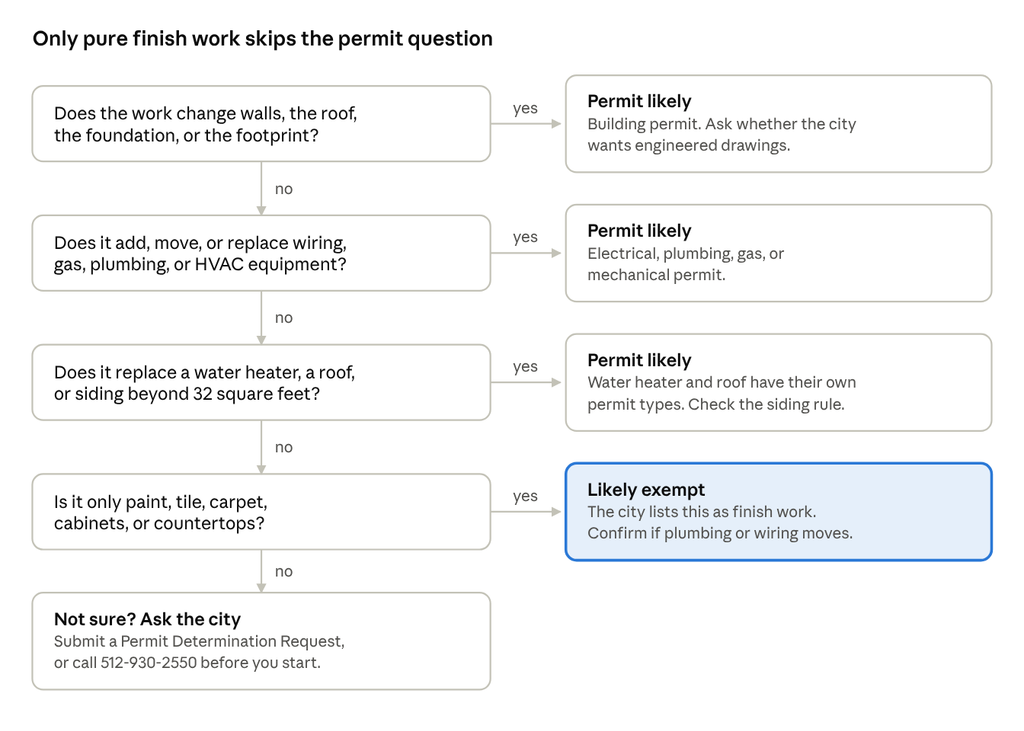
permit decision tree · 4 questions
The tree has one path to “likely exempt” and three paths to “permit likely.” If you land on neither, ask the city. Two more checks apply on top of the tree. If your home sits in the Downtown or Old Town overlay, exterior work may need a Certificate of Appropriateness. If your address is outside city limits, confirm which permits apply when Georgetown is your utility provider.
Examples: Kitchen, Bathroom, and Whole-House Projects
These scenarios show how the rules play out in real homes. They are general examples, not city rulings. Your project may differ, so confirm before you build.
A kitchen refresh: usually no permit
Say you replace the cabinets and counters, add a tile backsplash, and repaint. The layout stays the same. Appliances plug into outlets that already exist. This is finish work, and the city lists it as exempt.
Watch for one trap. A larger range or a new dishwasher may need a new circuit. That is electrical work, and it changes the answer. If you plan kitchen remodeling in Georgetown, TX, list every appliance change before you decide that no permit is needed.
A kitchen reconfiguration: permit likely
Now picture a different plan. You move the sink to an island. You take out the wall between the kitchen and the living room. You shift the range and extend a gas line.
Each move triggers its own review. The sink move involves plumbing. The wall involves structure. The new island outlets involve electrical work. The gas line involves gas. An experienced contractor bundles these into one remodel permit with the trade permits it needs. Plan for that review time when you read about a kitchen remodel timeline, because permit review sits before the first day of demolition.
A bathroom: it depends on what moves
A like-for-like swap is the easy case. New tile, a new vanity, and a toilet pulled and reset in the same spot usually stay in the finish-work category. The city’s exemption language covers removing and reinstalling a water closet when no pipes, valves, or fixtures are rearranged.
A layout change is different. Moving the shower drain, converting a tub to a walk-in shower with new plumbing, adding a new exhaust fan circuit, or installing heated floors with a dedicated circuit all point toward a permit. If you are weighing bathroom remodeling in Central Texas, ask your contractor which of those changes your plan includes.
A whole-house remodel: permit almost certain
Large projects touch many systems at once. You may open walls, rewire rooms, replace plumbing runs, and change the layout. Expect a remodel permit with separate trade permits. For owners planning full house remodeling, the permit is not a side task. It sets the order of work, the inspection stops, and the start date.
Smaller jobs owners forget
Some jobs sound minor but have their own permit types in Georgetown:
- Water heater replacement
- Roof replacement
- Siding replacement over 32 square feet, or any change in material
- Foundation repair
- Patio covers, decks, and flatwork
If your remodel list includes any of these, add them to the permit plan early.
Electrical, Plumbing, Mechanical, and Structural Work
Trade work is where most permit questions land. The city’s rule covers any new installation, alteration, repair, or replacement of these systems. The exemptions are narrow.
Electrical work
Permits apply to new circuits, new outlets, panel upgrades, added recessed lighting, and rewiring. The 2023 National Electrical Code sets the standard. In Texas, electricians are licensed through the Texas Department of Licensing and Regulation (TDLR).
The city’s exempt list is small. It includes replacing lamps, reinstalling receptacles, and replacing a breaker with one of the required capacity in the same location. It also covers low-voltage wiring that cannot supply more than 50 watts at under 25 volts. Anything beyond that needs a closer look.
Plumbing work
Moving fixtures, adding a bathroom, and replacing concealed drain or supply pipes all need permits. The city is direct on this point. If a concealed pipe fails and must be removed and replaced with new material, that is new work.
The exemptions cover stopping leaks, clearing stoppages, and repairing pipes, valves, or fixtures when nothing is replaced or rearranged. Plumbers in Texas are licensed by the Texas State Board of Plumbing Examiners. Water heater replacement has its own permit.
Mechanical and gas work
New or replacement HVAC equipment, new duct runs, and fixed gas lines fall under the permit rule. Portable heaters, portable coolers, and minor part replacements that do not change equipment approval are exempt. A new gas range connection is a good example of a small job that still needs review.
Structural work
Structure carries the most risk, so it draws the most scrutiny. Removing a load-bearing wall, adding a beam, widening an opening, or repairing a foundation all fall here. The city’s plan review may ask for engineered drawings. A licensed structural engineer sizes beams and posts so the load travels safely to the foundation.
Window and door changes can also be structural. Swapping a window in the same opening is one thing. Cutting a larger opening in a bearing wall is another. If your plan changes the size of an opening, ask the city first.
How the Permit and Inspection Process Works
Once you know you need a permit, the path is clear. It is also online, which saves trips to city offices.
- Confirm the permit type for your project.
- Create an account in My Government Online.
- Apply for a Residential Remodel and/or Addition permit, and upload plans and documents.
- Wait for plan review and answer any comments.
- Pay the fees and receive the permit.
- Schedule inspections online as work progresses.
- Pass the building final inspection.
This table shows what each stage involves, based on the city’s published process.
| Stage | What happens | What to expect |
|---|---|---|
| Application | You apply in MGO and upload plans and documents | Review starts once the city accepts the application |
| Plan review | City staff check the plans against adopted codes | 15 to 20 business days for residential plan review |
| Permit issued | You get an email notice with the permit amount | Work begins after the permit is issued |
| Inspections | You request each inspection online in MGO | Weekdays, 8:00 am to 3:30 pm. Request before 3:00 pm for next business day in most cases. No phone requests. Next-day service is not guaranteed |
| Building final | The inspector signs off on completed work | For residential homes, this serves as the certificate of occupancy |
What inspectors look for
Your permit page in MGO lists the inspections your project needs. Remodels commonly include a rough-in stage, when wiring, plumbing, or framing is visible, and a final stage. The key rule is simple: do not close up walls before rough-in work passes. Covering work early can mean tearing it open again.
What a permit costs
The city bases building permit fees on project valuation and posts a fee schedule. Check the current schedule before you set a budget. Then add the result to your whole-home remodel budget as its own line, next to design, materials, and a contingency.
Contractors, HOAs, Historic Overlays, and the Risk of Skipping a Permit
The permit itself is only part of the story. Several other approvals and habits shape how smoothly a remodel goes.
Who pulls the permit?
Ask your contractor before you sign. A reliable contractor tells you which permits the job needs and who will apply for them. Ask for the permit numbers once they are issued. You can then check status and inspection results in MGO.
Be careful if someone says a permit is not needed for work that clearly changes structure or systems. That answer should come with a reason you can check. If you plan to do any part of the work yourself, ask the city about owner permit rules and trade requirements first. Do not assume.
HOA rules are separate
Many Georgetown neighborhoods have homeowners associations. An HOA approval covers neighborhood rules, such as exterior colors or fences. It does not replace a city permit. A city permit does not replace HOA approval either. Handle both before work starts.
Downtown and Old Town overlays
Georgetown’s historic core has special review. The city lists a Certificate of Appropriateness for the Downtown and Old Town overlays as its own application. If your home sits in one of those areas, exterior changes may need that approval in addition to a building permit. Check early, because design review can affect your plans.
What skipping a permit can cost
Skipping a required permit rarely saves money in the end. The risks include:
- Stop-work orders and fines
- Opening finished walls so an inspector can see the work
- Being asked to remove or redo work that does not meet code
- Trouble at resale, since Texas seller’s disclosure forms ask about work done without permits
- Questions from insurers after a claim related to the unpermitted work
Permit fees are usually a small part of kitchen remodeling cost. Reopening a finished kitchen is not. The permit protects the money you already put into the room.
How to Check Permit Requirements Before You Build
A few steps take less than an hour. They can save weeks.
Confirm where your address falls
Use the city’s interactive maps to see whether your home is inside city limits. If it is not, check whether Georgetown provides your water, wastewater, or electric service. That decides which permit rules apply.
Read the city’s permit pages
Start with the city’s page on when a permit is required, then read the residential building permit page. They list the permit types, exempt work, adopted codes, and the review timeline. Spend ten minutes on the exempt list. It is short, and it answers many cosmetic-work questions.
Send a permit determination request
The city offers a way to submit a Permit Determination Request. Use it when your project sits in a gray area. Describe the work in plain terms. Say what moves, what stays, and which systems you will touch. You can also call the city’s permitting line at 512-930-2550 or email the permits team.
Write down the answer
Save the reply. Note the name of the person, the date, and any reference number. If a contractor, HOA, or buyer asks later, you have a record.
Build the permit into your timeline
Review takes 15 to 20 business days for residential plans, and inspections add stops along the way. That is why scope questions belong at the start. If you are planning a bathroom, read how long a bathroom remodel takes and add permit time before the work begins. Order materials with the same schedule in mind.
Questions worth asking the city
- Does my scope need a remodel permit, trade permits, or both?
- Will the city want engineered drawings?
- Which inspections will my permit require?
- Does my address fall in a historic overlay?
- What is the current fee for my project value?
Bring photos and a sketch of the plan. Clear information gets a clearer answer.
FAQs
Do I need a permit to replace kitchen cabinets in Georgetown?
Usually no. The city lists cabinets, countertops, and similar finish work as exempt. A permit becomes likely if the job also moves plumbing, adds circuits, or changes walls.
Do I need a permit to remodel a bathroom?
It depends on the scope. New tile, paint, and a like-for-like vanity are finish work. Moving a drain, adding a circuit, or changing the layout calls for a permit.
Can I remove a wall without a permit?
Plan on needing one. Removing or moving a wall is an alteration to the building. A load-bearing wall may also need an engineer’s drawings.
How long does a residential permit take in Georgetown?
The city lists residential plan review at 15 to 20 business days from the time it accepts your application. Simple or incomplete applications may move differently, so ask the city about your case.
Do I need inspections for a remodel?
If your project requires a permit, it also requires inspections. You request them online in MGO. The building final serves as the certificate of occupancy for residential homes.
What if my home is outside city limits?
Rules differ in the ETJ and in the county. Permits can still apply, especially for plumbing or electrical work, when Georgetown is your utility provider. Confirm your address with the city.
Final Thoughts
A remodel permit is not a hurdle to dread. It is a checkpoint that protects your home and your investment.
Here is the short version. Finish work like paint, tile, carpet, cabinets, and counters is usually exempt. Work on walls, roofs, foundations, and electrical, plumbing, gas, or mechanical systems usually is not. When your plan sits between the two, ask the City of Georgetown before you start and keep the answer in writing.
If you want a team that plans permits, inspections, and schedules into every job, talk with Rock Your House. Our crews handle remodeling across Central Texas and can walk you through what your project is likely to need. Visit Rock Your House to start the conversation and get your Georgetown remodel moving on solid ground.
Helpful Resources
City of Georgetown
- Siding Replacement requirements explains the 32 square foot like-for-like exemption.
From Rock Your House
Permit rules and fees change. Verify details with the City of Georgetown before you start work.