
A bathroom remodel can start with a simple idea. Replace the vanity. Update the tile. Install a better shower. Add more storage.
Then the project gets bigger.
You may find that the plumbing needs work. The shower needs a new waterproofing system. The floor is not level. Or the layout no longer works with the fixtures you want.
That is why asking, “What is the bathroom remodel cost in Central Texas?” does not have one simple answer.
A practical 2026 planning range is about $5,000 to $60,000 or more, depending on the bathroom and the scope. A cosmetic update can sit near the lower end. A standard full remodel often falls somewhere in the middle. A large primary bathroom with custom tile, a new shower layout, premium fixtures, and extensive plumbing work can move well above that range.
Current Austin cost data gives a useful local reference. Angi reports an average Austin bathroom remodel cost of about $13,211, with many projects ranging from $7,445 to $19,659. It also reports that Austin bathroom remodels can range from roughly $70 to $250 per square foot, depending on the project and finish level.
Those figures should not be treated as a quote for every home in Central Texas. They are a starting point.
The real cost comes from what you change, what stays in place, and what is hidden behind the finished surfaces.
This guide breaks down the major costs so you can create a realistic bathroom renovation budget before work begins.
What Does a Bathroom Remodel Cost in Central Texas?
For planning purposes, it helps to divide bathroom projects into three broad levels.
| Remodel level | Practical planning range | Typical scope |
| Cosmetic refresh | $5,000 to $12,000 | Paint, fixtures, vanity, lighting, minor surface updates |
| Standard full remodel | $15,000 to $30,000 | New tile, shower or tub, vanity, fixtures, flooring, lighting |
| Premium or major remodel | $30,000 to $60,000+ | Layout changes, custom shower, extensive tile, premium fixtures, upgraded plumbing and electrical |
These ranges are planning figures, not fixed market prices.
A small guest bathroom with an existing layout can cost much less than a primary bathroom with a custom shower and extensive tile.
The same bathroom can also have very different prices based on the materials selected.
A $5-per-square-foot tile and a $25-per-square-foot tile may look similar after installation. But the material cost is very different. Labor can also change when a tile is difficult to cut, requires a complex pattern, or needs additional preparation.
The project scope matters even more.
Keeping the toilet, shower, sink, and drain locations where they are can control costs. Moving them can introduce new plumbing work. Removing walls can add structural and electrical work. Increasing the shower size can affect waterproofing, drainage, glass, tile, and plumbing.
That is why a good estimate starts with the existing bathroom, not just a list of products.
Why Central Texas Bathroom Costs Can Vary So Much
Central Texas is not one uniform construction market.
A bathroom remodel in Austin may have different labor, permitting, and material costs than a project in Leander, Cedar Park, Georgetown, or another nearby community.
The home itself also matters.
A newer home may have more predictable plumbing and electrical systems. An older home can require more investigation. Previous remodeling work may also create surprises.
There are several cost variables that repeatedly have the largest effect on a bathroom renovation budget.
Bathroom Size
Size matters, but it is not the only factor.
A larger bathroom needs more flooring, wall tile, paint, lighting, and sometimes more cabinetry. A large shower also requires more waterproofing and tile.
However, a small bathroom can still be expensive.
Why?
Because many major costs are not priced strictly by square footage.
You still need a plumber. You still need an electrician when electrical work is involved. You still need demolition, disposal, waterproofing, installation, and project management.
A 40-square-foot bathroom does not necessarily cost half as much as an 80-square-foot bathroom.
This is one reason cost-per-square-foot figures should be used carefully.
Layout Changes
The existing layout is one of the biggest cost controls available to a homeowner.
Suppose the toilet is in the right location. The shower is in the right location. The vanity works for the room.
You could replace the finishes without moving major plumbing.
Now compare that with moving the shower across the room.
The project may require new supply lines, new drain routing, additional framing, new waterproofing, and more floor or wall work.
The visible change may look simple.
The construction work behind it is not.
A layout change can be worthwhile if it solves a real problem. For example, a poor bathroom layout may leave too little clearance around the toilet or create an awkward shower entrance.
The important point is to price the complete change before deciding.
The Condition of the Existing Bathroom
Demolition is not only about removing old finishes.
Once tile, drywall, flooring, or a tub surround comes out, the underlying condition becomes easier to inspect.
You may find damaged subfloor, old plumbing, poor previous repairs, moisture damage, improper framing, outdated electrical components, or inadequate ventilation.
Not every bathroom has these issues.
But a responsible bathroom renovation budget should allow for some uncertainty.
A contingency of around 10% to 15% is a useful planning approach for many renovation projects. The right amount depends on the age and condition of the home and how much demolition is involved.
How Much Does a Shower Remodel Cost?
The shower is often one of the most important parts of the bathroom budget.
It is also one of the areas where construction quality matters most.
Current Austin data from Angi puts shower remodeling at an average of about $6,867, with reported project ranges from roughly $1,962 to $8,829. The same source reports that new shower plumbing can add substantial cost when the layout changes.
Your Central Texas project may fall outside those figures.
The shower type makes a major difference.
Prefabricated Shower Systems
A prefabricated shower system can reduce installation complexity.
These systems use manufactured panels or kits rather than individual tile pieces across the entire shower.
They can make sense when the homeowner wants a faster installation, fewer grout joints, easier maintenance, and a more controlled material budget.
They do not automatically mean low quality.
The key is proper installation and compatibility with the existing bathroom.
Tiled Walk-In Showers
A tiled walk-in shower usually requires more labor.
There are more individual materials and more installation steps.
The contractor may need to build or modify the shower walls, shower floor, curb or curbless entry, niches, bench, drain, waterproofing, tile layout, and glass enclosure.
The tile itself is only one part of the cost.
Waterproofing is especially important.
A beautiful shower can still become a costly problem if water gets behind the finished surfaces.
Shower Systems and Fixtures
The shower valve and fixtures can also affect the budget.
A basic shower may have one showerhead and a standard valve.
A more advanced system might include a hand shower, multiple body sprays, thermostatic controls, rain showerhead, or separate volume controls.
Every additional fixture can add material and installation work.
It can also affect the plumbing requirements.
This is why it is better to select the shower system early in the design process.
Why Waterproofing Deserves a Real Budget
Waterproofing is one of the least visible parts of a bathroom remodel.
It is also one of the most important.
Tile and grout create the finished appearance. They do not serve as the complete waterproofing strategy for a shower.
A properly designed shower needs a water-management system that addresses the walls, floor, penetrations, corners, seams, and drainage.
The exact system may vary by construction method and product.
Common approaches include waterproof membranes, bonded waterproofing systems, waterproof backer products, and other approved assemblies.
The important thing is that the entire system works together.
Waterproofing Is Not a Place to Cut Costs Blindly
If the project budget becomes tight, homeowners often look at visible finishes first.
That makes sense.
You can change a tile selection. You can choose a different faucet. You can use a simpler mirror.
Cutting necessary waterproofing work is different.
A shower is exposed to water every day. Poor installation can create damage that is expensive to correct because the finished tile may need to be removed.
A strong bathroom renovation budget treats waterproofing as part of the core construction, not an optional upgrade.
How Much Does Bathroom Tile Cost?
Tile can have a major effect on the final price.
The material is only one part of the equation.
You also need to consider surface preparation, waterproofing, tile installation, grout, edge treatment, cuts around plumbing, niches, patterns, and demolition.
Austin data from Angi shows a broad range of bathroom flooring materials, with ceramic and porcelain materials ranging from about $2 to $31 per square foot and marble from about $5 to $36 per square foot. These are material ranges, not complete installed prices.
Floor Tile
Floor tile usually covers less area than all the shower walls.
But the floor can still become expensive when the design uses small-format tile, intricate patterns, premium materials, or extensive preparation.
Small tiles also mean more grout joints.
That can affect both labor and maintenance.
Shower Wall Tile
Shower walls can consume a surprising amount of material.
A standard shower may require tile across three walls. A larger walk-in shower can require much more.
Then there are design choices.
A simple vertical installation is generally less labor-intensive than a detailed pattern with multiple tile sizes.
Large-format tile can reduce the number of grout joints, but it may require more careful handling and a flatter substrate.
Decorative Tile
Accent tile can create a strong visual change without covering the entire room.
For example, a homeowner might use a standard porcelain tile across the shower and place a more expensive tile in the niche or on one feature wall.
This can provide a higher-end appearance while keeping material use under control.
The same principle applies to mosaic tile.
Use it where it adds value to the design instead of automatically covering every surface.
Vanity and Cabinetry Costs
The vanity is another major bathroom cost.
A simple stock vanity can be relatively affordable.
A custom vanity can cost considerably more.
The final price depends on the vanity size, material, construction quality, number of drawers, door style, countertop, sink configuration, hardware, and custom dimensions.
If the bathroom has an unusual wall or limited space, custom cabinetry may make more sense.
For a standard bathroom, however, a well-selected stock or semi-custom vanity may provide better budget control.
Countertop Material
Quartz is popular because it offers a broad range of colors and patterns and is relatively low maintenance.
Natural stone can create a different appearance but may require more care depending on the material.
Laminate and other manufactured surfaces can offer a lower-cost alternative.
The countertop should be considered with the vanity rather than as a separate purchase.
The sink style matters too.
An undermount sink, integrated sink, vessel sink, or other configuration can change fabrication and installation requirements.
Plumbing Costs and Fixture Changes
Plumbing is where a bathroom renovation can become much more involved.
Replacing a faucet is not the same as relocating a shower.
Replacing a toilet in the same location is not the same as changing the drain location.
That difference should be clear when reviewing an estimate.
Keeping Plumbing in Place
Keeping existing fixture locations is often one of the simplest ways to manage the budget.
You can still create a major visual change.
For example, you could replace the vanity, countertop, faucet, toilet, shower fixtures, tub, tile, mirror, and lighting.
The room can look completely different without major drain relocation.
Moving Plumbing
Moving plumbing may make sense when the current layout is inefficient.
But the cost can include more than the plumbing itself.
Flooring may need to be removed.
Walls may need to be opened.
New penetrations may need to be created.
The project may also require additional framing or repairs.
If a layout change is being considered, ask for two estimates.
One should keep the existing plumbing locations.
The other should show the proposed changes.
That makes the financial tradeoff much easier to evaluate.
Electrical Work in a Bathroom Remodel
Modern bathrooms often need more electrical functionality than older bathrooms had.
You may want better vanity lighting, recessed lights, an exhaust fan, a heated floor, a backlit mirror, additional outlets, improved switches, or smart controls.
Each item has its own installation requirements.
Wet locations also have electrical safety considerations.
GFCI protection is an important part of bathroom electrical planning. Local requirements and the applicable electrical code should be confirmed for the property and project.
A bathroom remodel is a good time to address poor lighting.
The vanity area deserves particular attention.
A single overhead light can create shadows on the face. Layered lighting can make shaving, makeup application, grooming, and other daily tasks easier.
Ventilation Is Part of the Bathroom Budget
Bathrooms produce moisture.
Showers create a large amount of warm, humid air in a short period.
That moisture needs a way out.
A properly sized and installed exhaust fan can help control humidity and protect the room from moisture-related problems.
When remodeling, check whether the existing fan works properly.
Also check where it vents.
An exhaust fan that does not move air effectively may need replacement.
Ventilation work may add to the budget, but it can be an important part of protecting the finished bathroom.
Fixtures Can Move the Budget Quickly
A bathroom contains many fixtures.
Some are obvious, such as the toilet and sink.
Others are smaller but still affect the final cost.
Faucets, shower valves, showerheads, tub fillers, towel bars, toilet paper holders, mirrors, cabinet hardware, lighting, and shower doors can all affect the total.
A common budgeting mistake is selecting premium fixtures one at a time.
Each individual upgrade may seem reasonable.
Together, they can add thousands of dollars.
Create a fixture allowance before shopping.
For example, set a budget for the faucet, shower system, vanity, mirror, lighting, and hardware.
Then shop within those limits.
Shower Door and Glass Costs
Glass can become a significant part of a walk-in shower.
A framed door is generally different in cost and appearance from a frameless enclosure.
A custom glass enclosure can also vary based on size, glass thickness, door configuration, hardware finish, number of panels, and shower shape.
A fixed glass panel may be simpler than a large multi-panel enclosure with a hinged door.
If you are designing a custom shower, include glass in the early budget.
Do not leave it as an afterthought.
Labor Can Represent a Large Share of the Budget
Bathroom remodeling involves several skilled trades.
Depending on the project, you may need a combination of general remodeling labor, plumbing, electrical, tile installation, drywall, painting, glass installation, and cabinet installation.
Labor is not simply the time spent putting products in place.
It includes preparation, sequencing, coordination, protection, cleanup, inspection, and corrections.
Current Austin shower remodeling data from Angi estimates labor at roughly 25% to 40% of the total shower remodeling cost. More complicated projects can require a higher labor share because of the number of trades and construction steps involved.
This is one reason two bathrooms with similar material selections can have very different project totals.
What Is Usually Included in a Bathroom Remodel Estimate?
A detailed estimate should make the scope clear.
Depending on the contractor and project, an estimate may include several stages of work.
Demolition
This can include removing old tile, flooring, cabinets, fixtures, drywall, tubs, or shower surrounds.
Disposal should also be addressed.
Framing and Surface Preparation
Walls may need repair or modification.
Floors may need leveling.
Substrates may need replacement.
Plumbing
This can range from fixture replacement to major supply and drain changes.
Electrical
Lighting, outlets, switches, fans, heated floors, and other electrical components may be included.
Waterproofing
This is especially important around showers and other wet areas.
Tile Installation
The estimate should make clear whether it includes material, setting materials, grout, trim, and labor.
Cabinets and Countertops
Vanity installation and countertop fabrication may be included as separate line items.
Painting
Some contractors include painting. Others price it separately.
Fixtures and Finish Installation
Toilets, faucets, mirrors, hardware, shower doors, and other accessories may have separate labor or allowance costs.
A detailed estimate makes comparison easier.
A low bid is not always a lower-cost project if major items are missing from the scope.
A Simple Bathroom Renovation Budget Example
Consider a 70-square-foot guest bathroom in Central Texas.
The homeowner wants to keep the existing layout.
The scope includes a new vanity, quartz countertop, new faucet, new toilet, new shower valve and showerhead, new shower tile, new bathroom floor tile, new mirror, new lighting, a new exhaust fan, and fresh paint.
This is a very different project from moving the toilet and expanding the shower.
If the existing plumbing and framing are in good condition, the project may stay within a moderate budget.
Now add a few changes.
The homeowner wants a larger walk-in shower, a bench, a niche, frameless glass, a new shower drain location, full-height tile, premium fixtures, and heated flooring.
The budget can move substantially higher.
The square footage did not change much.
The scope did.
That is the most important idea to keep in mind when estimating a bathroom remodel.
A Primary Bathroom Costs More Than a Small Guest Bath
Primary bathrooms often have more fixtures and more design requirements.
They may include a double vanity, large walk-in shower, freestanding tub, separate toilet area, custom storage, more lighting, more tile, larger mirrors, and heated floors.
The room may also be larger.
This increases both material and labor requirements.
A primary bathroom remodel can therefore move into the $30,000 to $60,000+ range when the project includes major layout changes and premium finishes.
There is no universal upper limit.
Custom stone, specialty plumbing, high-end glass, extensive electrical work, and structural changes can push the cost much higher.
How Much Does a Small Bathroom Remodel Cost?
Small bathrooms can be less expensive, but they are not automatically cheap.
Current Austin data from Angi places the average small bathroom remodel at about $6,377, with reported project costs ranging from $1,472 to $14,715.
Again, Central Texas projects vary.
A small powder room with new paint, lighting, mirror, faucet, and vanity may stay relatively simple.
A small bathroom with a complete shower replacement can be more expensive.
A small room can also have design challenges.
Every inch matters.
For example, a larger vanity may look attractive in a showroom but make a narrow bathroom difficult to use.
Good design is not about filling the room.
It is about using the available space efficiently.
How Layout Changes Affect Your Bathroom Renovation Budget
Layout changes deserve their own budget discussion because they affect several trades at once.
Imagine a bathroom where the toilet sits beside the vanity.
The homeowner wants the toilet moved to another wall.
That may require new drain routing, new water supply routing, floor opening, subfloor repair, possible framing work, and new finished flooring.
The cost is not simply the plumber’s labor.
The change can trigger work throughout the bathroom.
This does not mean you should never move plumbing.
It means the benefit should justify the additional construction.
If moving the shower creates a much better bathroom for the next 10 or 15 years, it may be worth the investment.
Permits and Inspections
Permit requirements vary by jurisdiction and by the type of work being performed.
Austin, for example, identifies certain bathroom remodels as eligible for an express permit process when they meet specific limitations. Its guidance notes that walls cannot be relocated or removed and plumbing fixtures cannot be relocated or added under that qualified express bathroom remodel category. Trade permits may also be required depending on the work.
That illustrates an important point.
“Bathroom remodel” is not a single permit category everywhere.
Your project could involve plumbing, electrical, mechanical, structural, or building requirements.
Before work starts, confirm the requirements for the specific property and jurisdiction.
Permit fees are only one part of the issue.
Inspections can also affect scheduling.
A good remodeling plan accounts for them from the beginning.
Should You Remodel Everything at Once?
Not always.
Sometimes a phased project makes sense.
For example, a homeowner may have a limited budget today but expect to complete more work later.
However, phasing can sometimes increase total costs.
If the shower must be demolished now and the vanity area is renovated later, some labor and preparation may be duplicated.
If the entire bathroom is already being opened, it may be more efficient to address related issues at the same time.
Ask for both options.
Compare the cost of doing the full project now with the cost of completing it in phases.
Where You Can Save Money Without Sacrificing Function
A lower bathroom renovation budget does not require choosing the cheapest product everywhere.
It requires spending money where it has the most impact.
Keeping the existing layout is often the biggest budget control. Avoid moving drains and water lines unless the layout problem is significant.
Tile is another place where you have flexibility. You do not need the most expensive tile in every location. Use a higher-end tile as an accent and a more affordable tile across larger surfaces.
Standard vanity sizes can also help control costs. Custom dimensions are useful when the room requires them, but they can add cost.
Complex tile patterns can increase installation time. If you want a decorative pattern, use it in a focused area.
Spend more on items you use every day. The shower valve, faucet, toilet, and vanity hardware can deserve more attention than a decorative accessory.
A bathroom also does not need dozens of different materials. Two or three well-coordinated finishes can look more intentional than a room packed with competing products.
Where Cutting Costs Can Backfire
Some budget reductions can create problems later.
Be cautious about cutting waterproofing, drainage, necessary plumbing repairs, electrical safety work, proper surface preparation, ventilation, structural repairs, or quality installation.
These are not simply cosmetic decisions.
If the finished tile looks good but the shower was not properly waterproofed, the project has not solved the underlying problem.
This is an important distinction when comparing estimates.
A contractor who includes the correct preparation and waterproofing may appear more expensive than one who leaves those details vague.
The lower number may not represent the lower total project cost.
How to Compare Bathroom Remodeling Quotes
Do not compare contractors based only on the final number.
Compare the scope.
Ask each contractor what is being demolished. Does the price include removal of the old tub, tile, vanity, flooring, and drywall? Make sure disposal is also addressed.
Ask what happens behind the walls. Does the estimate include necessary plumbing, framing, and substrate repairs?
Ask what waterproofing system will be used. The proposal should make the wet-area construction clear.
Review material allowances. A quote with a low allowance for tile or fixtures may look inexpensive until actual selections are made.
Confirm who handles permits and inspections.
Finally, ask how changes are handled. Renovation projects can change when hidden conditions appear. The contract should explain how additional work is approved and priced.
A detailed proposal gives you a much better basis for comparison.
How to Build a Bathroom Renovation Budget Before Shopping
Start with the construction scope.
Do not begin by choosing faucets.
Write down what you actually want to change.
For example:
Existing layout: Keep.
Shower: Replace tub with walk-in shower.
Tile: Porcelain floor and shower tile.
Vanity: 60-inch double vanity.
Countertop: Quartz.
Fixtures: Mid-range.
Lighting: New vanity and ceiling lighting.
Ventilation: Replace exhaust fan.
Paint: Full room.
Then divide the budget into categories.
A useful structure is:
| Budget category | What to include |
| Demolition | Removal, hauling, disposal |
| Plumbing | Fixtures, supply lines, drains, rough plumbing |
| Electrical | Lighting, outlets, fan, controls |
| Shower | Pan, waterproofing, fixtures, glass |
| Tile | Materials, setting materials, labor |
| Vanity | Cabinet, sink, countertop, hardware |
| Finishes | Mirror, paint, accessories, lighting |
| Permits | Applicable permits and inspections |
| Contingency | Unexpected conditions and approved changes |
This prevents a common problem.
You can see the vanity price.
You can see the tile price.
But you may forget the smaller construction costs that make the project possible.
What Makes a Bathroom Remodel More Expensive?
The following factors usually push the budget upward.
Moving multiple fixtures is one of the biggest factors. Moving a toilet, shower, tub, and vanity can create extensive plumbing work.
Enlarging the shower can also add several costs at once. A larger shower means more waterproofing, tile, glass, and potentially more plumbing.
Custom tile designs can increase labor. Patterns, mosaics, multiple tile sizes, and complex cuts take more time to install.
Premium fixtures can also have a noticeable impact. Luxury shower systems and specialty plumbing fixtures can add thousands of dollars.
Custom cabinetry can solve difficult layouts but usually costs more than standard units.
Heated floors require electrical planning and appropriate installation.
Structural changes can add another layer of work. Wall removal, new openings, or framing changes may involve engineering or permitting.
Finally, older bathrooms can require more corrective work because of aging plumbing, wiring, moisture damage, or previous poor workmanship.
What Makes a Bathroom Remodel Less Expensive?
A simpler project usually has several characteristics.
The existing layout works.
The plumbing is in good condition.
The electrical system needs only minor updates.
The homeowner selects readily available materials.
The shower design is straightforward.
The tile pattern is simple.
The vanity is a standard size.
The project avoids unnecessary structural changes.
This type of project can deliver a significant visual improvement without turning into a complete reconstruction.
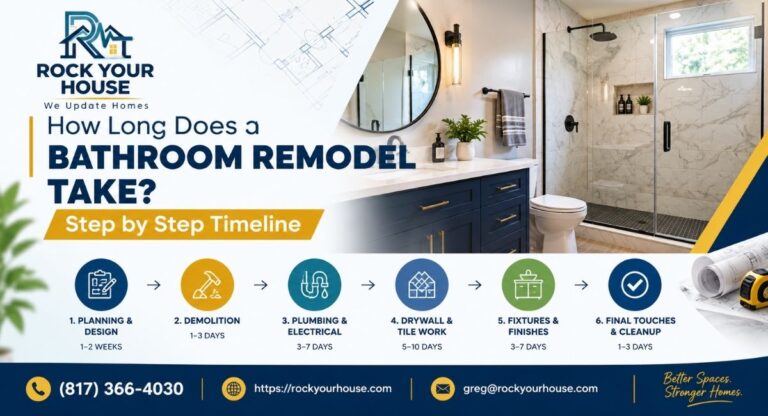
A Bathroom Remodel Timeline Can Affect Cost
Time is another part of the budget.
A typical bathroom renovation involves several stages.
Planning and Selection
You decide the layout, materials, fixtures, colors, lighting, and storage.
Demolition
Existing finishes and fixtures are removed.
Rough Work
Plumbing, electrical, framing, and other work behind the finished surfaces is completed.
Waterproofing and Surface Preparation
The shower and other wet areas are prepared before tile installation.
Tile and Flooring
The finished surfaces are installed.
Cabinetry and Countertops
The vanity and countertop are installed.
Fixtures and Finishing
Faucets, toilet, shower fixtures, mirrors, lights, glass, hardware, and accessories are completed.
Final Inspection and Punch List
The contractor addresses remaining issues and completes the final details.
The sequence matters.
A delayed vanity can affect countertop installation. A delayed shower fixture can affect final plumbing work. A custom glass enclosure generally cannot be measured and installed until the shower opening is ready.
Planning selections early can reduce avoidable delays.
Real-World Scenario: A $10,000 Bathroom vs. a $35,000 Bathroom
Consider two homeowners with bathrooms of similar size.
Bathroom A
The homeowner keeps the existing layout.
They replace the vanity, countertop, mirror, lighting, toilet, faucet, and shower fixtures. They install new flooring and repaint the room.
There is no major plumbing relocation.
The shower structure is in good condition.
This type of project could fit within a lower or mid-range renovation budget, depending on the products and labor required.
Bathroom B
The homeowner removes a tub.
They create a large walk-in shower.
The shower gets a custom waterproofing system, niche, bench, premium tile, frameless glass, and upgraded fixtures.
The vanity becomes a custom double vanity.
The floor gets new tile with electrical heating.
The lighting and electrical layout are updated.
This is no longer a simple cosmetic remodel.
A budget around $35,000 or more may be reasonable depending on the selections and construction requirements.
The square footage did not change much.
The scope did.
That is the most important idea to keep in mind when estimating a bathroom remodel.
A Primary Bathroom Costs More Than a Small Guest Bath
Primary bathrooms often have more fixtures and more design requirements.
They may include a double vanity, large walk-in shower, freestanding tub, separate toilet area, custom storage, more lighting, more tile, larger mirrors, and heated floors.
The room may also be larger.
This increases both material and labor requirements.
A primary bathroom remodel can therefore move into the $30,000 to $60,000+ range when the project includes major layout changes and premium finishes.
There is no universal upper limit.
Custom stone, specialty plumbing, high-end glass, extensive electrical work, and structural changes can push the cost much higher.
How Much Does a Small Bathroom Remodel Cost?
Small bathrooms can be less expensive, but they are not automatically cheap.
Current Austin data from Angi places the average small bathroom remodel at about $6,377, with reported project costs ranging from $1,472 to $14,715.
Again, Central Texas projects vary.
A small powder room with new paint, lighting, mirror, faucet, and vanity may stay relatively simple.
A small bathroom with a complete shower replacement can be more expensive.
A small room can also have design challenges.
Every inch matters.
For example, a larger vanity may look attractive in a showroom but make a narrow bathroom difficult to use.
Good design is not about filling the room.
It is about using the available space efficiently.
How Layout Changes Affect Your Bathroom Renovation Budget
Layout changes deserve their own budget discussion because they affect several trades at once.
Imagine a bathroom where the toilet sits beside the vanity.
The homeowner wants the toilet moved to another wall.
That may require:
- New drain routing.
- New water supply routing.
- Floor opening.
- Subfloor repair.
- Possible framing work.
- New finished flooring.
The cost is not simply the plumber’s labor.
The change can trigger work throughout the bathroom.
This does not mean you should never move plumbing.
It means the benefit should justify the additional construction.
If moving the shower creates a much better bathroom for the next 10 or 15 years, it may be worth the investment.
Permits and Inspections
Permit requirements vary by jurisdiction and by the type of work being performed.
Austin, for example, identifies certain bathroom remodels as eligible for an express permit process when they meet specific limitations. Its guidance notes that walls cannot be relocated or removed and plumbing fixtures cannot be relocated or added under that qualified express bathroom remodel category. Trade permits may also be required depending on the work.
That illustrates an important point.
“Bathroom remodel” is not a single permit category everywhere.
Your project could involve plumbing, electrical, mechanical, structural, or building requirements.
Before work starts, confirm the requirements for the specific property and jurisdiction.
Permit fees are only one part of the issue.
Inspections can also affect scheduling.
A good remodeling plan accounts for them from the beginning.
Should You Remodel Everything at Once?
Not always.
Sometimes a phased project makes sense.
For example, a homeowner may have a limited budget today but expect to complete more work later.
However, phasing can sometimes increase total costs.
If the shower must be demolished now and the vanity area is renovated later, some labor and preparation may be duplicated.
If the entire bathroom is already being opened, it may be more efficient to address related issues at the same time.
Ask for both options.
Compare the cost of doing the full project now with the cost of completing it in phases.
Bathroom Remodeling in Leander, Cedar Park, and Nearby Communities
Local conditions can affect the project.
Homes in Leander, Cedar Park, Georgetown, and surrounding communities can differ by age, construction type, neighborhood, and previous renovation history.
That means two bathrooms with the same dimensions can still produce different estimates.
If your home is in Georgetown, reviewing local remodeling information can be useful before setting a budget. Bathroom remodeling in Georgetown, TX can provide additional context.
Cedar Park homeowners can also review information specific to bathroom remodeling Cedar Park TX before planning the scope.
For broader projects that involve several rooms, a bathroom remodel may also be part of a larger full house renovation in Central Texas.
The right approach depends on whether the bathroom is an isolated project or part of a larger renovation plan.
Bathroom Remodel vs. Full House Renovation
Sometimes a bathroom problem is not isolated.
You may be updating the bathroom while also changing flooring, doors, paint, kitchens, or other areas.
In that situation, coordinating the work can be more efficient.
A full house remodeling project can combine multiple renovation needs under one larger plan.
This does not mean every homeowner should remodel the entire house.
If the bathroom is the only space that needs work, a focused renovation may make more sense.
The important thing is to look at the home as a whole before making major layout decisions.
Is a Bathroom Remodel Worth the Cost?
The value of a bathroom remodel is not only financial.
A well-planned renovation can improve daily comfort, storage, lighting, shower access, cleaning, bathroom ventilation, water management, overall appearance, and functionality.
Financial return varies by project and market.
There is no reliable rule that says every dollar spent on a bathroom returns a specific amount when the home is sold.
A bathroom that fixes poor function and dated finishes can be appealing to buyers.
But personal taste matters.
A very expensive custom bathroom may not return its full cost at resale.
For that reason, choose upgrades based on how you intend to use the home, not just a predicted resale figure.
Bathroom Renovation Budget Mistakes to Avoid
Mistake 1: Budgeting Only for Materials
The tile, vanity, and faucet are easy to price.
Demolition, preparation, labor, plumbing, electrical work, waterproofing, permits, and disposal are just as important.
Mistake 2: Using One Online Average as Your Budget
An average is based on a collection of projects.
Your bathroom has its own conditions.
Use averages to establish a starting range, then adjust for your scope.
Mistake 3: Moving Plumbing Without Pricing the Full Impact
Moving one fixture can affect several parts of the room.
Get the complete cost before approving the layout.
Mistake 4: Choosing Fixtures Too Late
A shower valve or vanity may have specific installation requirements.
Select important fixtures early enough for the construction plan.
Mistake 5: Forgetting Glass
A custom shower can require a substantial glass budget.
Include it from the beginning.
Mistake 6: Ignoring Ventilation
A new bathroom should have a sensible moisture-control plan.
Do not focus only on tile and fixtures.
Mistake 7: Spending the Entire Budget on Finishes
Keep money available for construction.
Beautiful materials cannot compensate for poor preparation.
Frequently Asked Questions About Bathroom Remodeling Cost
How much does a bathroom remodel cost in Central Texas?
A practical planning range is about $5,000 to $60,000 or more. A cosmetic update may fall near the lower end. A standard full remodel often lands in the middle. A premium primary bathroom with layout changes and custom finishes can exceed $60,000. Local Austin data provides a useful reference, with Angi reporting an average of $13,211 and a common range of $7,445 to $19,659 in its 2026 data.
What is the biggest bathroom remodeling cost?
Labor and construction scope are often major cost drivers. Shower work, tile, plumbing changes, cabinetry, and waterproofing can each have a significant effect. The biggest cost is not always the most expensive product. A layout change can create costs across multiple trades.
How much does a walk-in shower cost in Central Texas?
A walk-in shower can range widely based on size, tile, waterproofing, glass, plumbing, and fixtures. Current Austin estimates from Angi put many walk-in shower installations in the several-thousand-dollar range, while more elaborate wet-room and custom shower projects can cost substantially more.
Is it cheaper to remodel a bathroom without moving plumbing?
Usually, keeping the existing plumbing locations can help control costs.
Moving plumbing can require opening floors and walls and can create additional work for several trades.
However, keeping a poor layout simply to save money is not always the best decision. Price both options before choosing.
How much should I set aside for unexpected bathroom remodeling costs?
A contingency of around 10% to 15% can be a useful planning range. Older bathrooms and projects involving extensive demolition may justify a larger reserve.
The actual amount depends on the condition of the home and the scope of work.
Does tile make a bathroom remodel more expensive?
It can.
Tile cost depends on the material, size, pattern, surface preparation, installation complexity, grout, and amount of coverage.
A large shower covered in premium tile can require much more labor than a basic tub surround.
Does a bathroom remodel require a permit?
It depends on the jurisdiction and the work.
Plumbing, electrical, structural, and layout changes can have different requirements. Austin, for example, has a qualified express permit category for certain bathroom remodels, but that category has specific limitations.
Check the requirements for your property before construction begins.
Should I remodel a bathroom in stages?
Sometimes.
A phased approach can help when cash flow is limited.
But if multiple components need to be opened or removed, completing related work together can sometimes avoid duplicated labor.
Compare both approaches before deciding.
Helpful Resources for Planning a Bathroom Remodel
For local permit information, homeowners can review the City of Austin Development Services permit guidance to see how certain bathroom remodels are handled and what limitations may apply.
For planning purposes, it is also useful to keep a written scope, a materials list, a fixture allowance, and a contingency reserve.
If you are working with a contractor, ask for a detailed proposal rather than relying on a single total price.
For homeowners looking at a broader renovation, reviewing the available bathroom remodeling services in Central Texas can also help clarify what may be included in a professionally managed project.
Final Takeaway: Plan the Scope Before You Set the Price
So, how much does a bathroom remodel cost in Central Texas?
The most useful answer is a range, not one number.
For a basic refresh, you might plan around $5,000 to $12,000.
For a more complete bathroom renovation, $15,000 to $30,000 is a useful planning range.
For a large primary bathroom with a custom shower, extensive tile, premium fixtures, plumbing changes, and other upgrades, $30,000 to $60,000+ can be a realistic starting point.
Your actual cost depends on the bathroom size, layout, existing conditions, materials, labor, fixtures, waterproofing, plumbing, electrical work, permits, and design complexity.
The most effective way to control the budget is to decide what the bathroom needs before choosing individual products.
Keep the layout when it works.
Spend carefully on tile and fixtures.
Do not cut corners on waterproofing or necessary construction.
Keep a contingency for hidden conditions.
And compare contractor proposals based on the complete scope, not just the bottom-line number.
If you are ready to turn a bathroom idea into a defined project, Rock Your House can help you evaluate the scope and plan the renovation around your home’s needs and your budget.
The best bathroom remodel is not necessarily the most expensive one. It is the one where the money goes toward the changes that improve the space, the construction is handled correctly, and the final result fits the way you actually live.